Terms each tool uses
- Trace: one request through your application, start to finish. LangSmith and Langfuse both call it a trace.
- Observation or run: one step inside a trace, such as a model call or a tool call. Langfuse calls it an observation and LangSmith a run, and both say it is what OpenTelemetry calls a span.
- Session or thread: the traces of one multi-turn conversation. Langfuse calls it a session and LangSmith a thread.
- Score: an evaluation result attached to a trace or one of its steps. Langfuse calls it a score, and on LangSmith an evaluator adds feedback to a trace.
What LangSmith and Langfuse each set out to do
LangSmith is LangChain's platform for tracing, evaluating and deploying agents. It instruments LangChain apps automatically. Other apps use its SDK wrappers or OpenTelemetry, so you do not need LangChain to use it. Its strength is that tracing, evaluators, alerts and managed deployment of long-running agents come from one vendor.
Langfuse is an open-source tracing and evaluation platform with Python and JavaScript SDKs built on OpenTelemetry. It accepts OpenTelemetry spans at an OTLP endpoint, and it adds LLM-as-a-judge evaluators, datasets, experiments and annotation queues. Its core is under the MIT license, and the license's copyright line names ClickHouse, Inc., which now owns Langfuse.
Both tools trace production traffic and run evaluations, and both can send an alert when something crosses a threshold. So at volume, the difference between Langfuse and LangSmith comes down to what each one bills on, how long it keeps a trace, and what it takes to run.
How LangSmith and Langfuse pricing grows as your agents get deeper
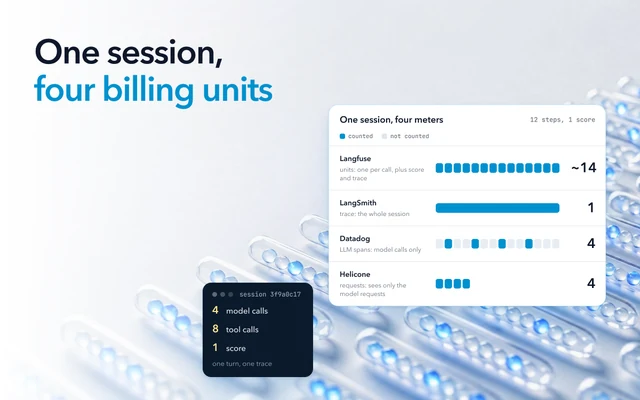
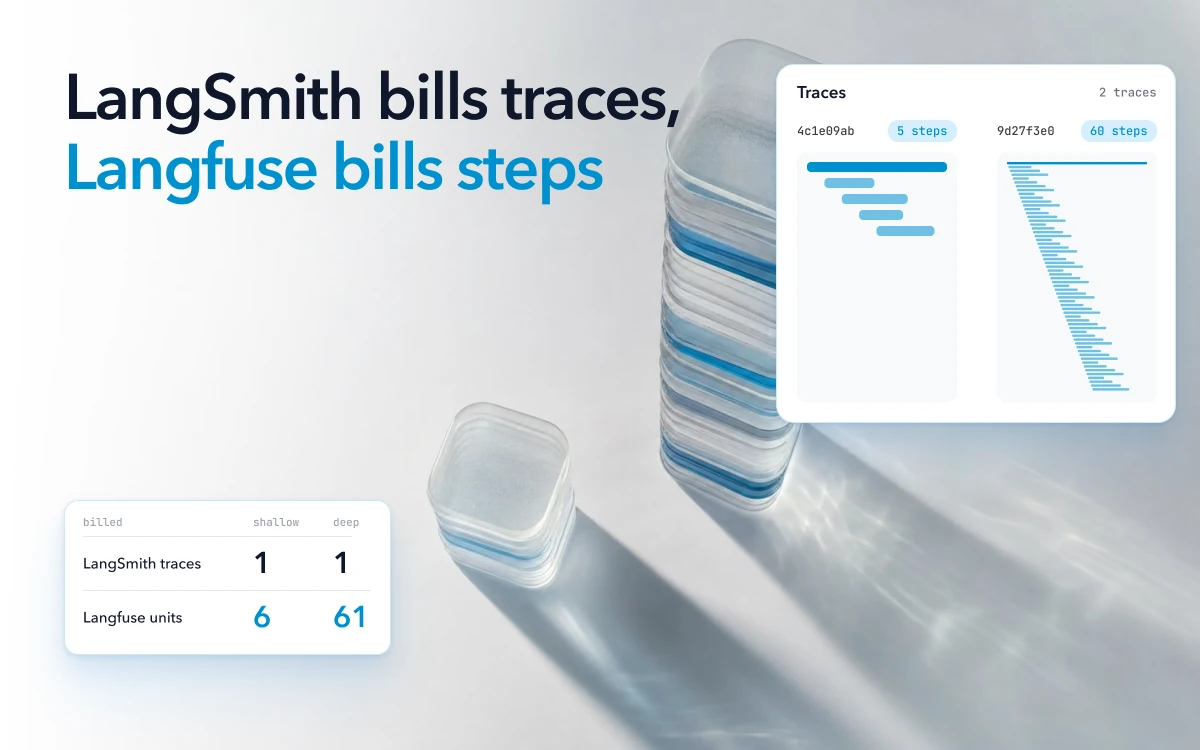
A LangSmith bill grows with the number of traces, and a Langfuse bill grows with the number of observations.
LangSmith bills seats and traces. A trace is one request through your application, however many steps it holds. On the Plus plan, as of October 2026, each seat costs $39 a month and every invited user counts as a seat. Plus includes 10,000 base traces a month. The free Developer plan has one seat and 5,000 base traces. After that, each base trace costs 0.005 LSU. An LSU, or LangChain Standard Unit, is LangChain's billing unit, and 1 LSU is $1, so 1,000 base traces cost $5.
A base trace is LangSmith's default tier, kept for 14 days. You can upgrade a trace to the extended tier, which keeps it for 180 days, for another 0.0025 LSU.
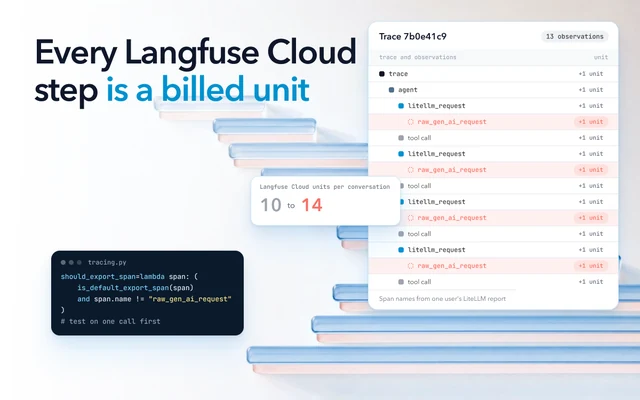
Langfuse bills units, and it counts each trace, observation and score as a unit. Units created by Langfuse's own features, such as its LLM-as-a-judge evaluators, count too.
On Langfuse Cloud, as of October 2026, the Core plan is $29 a month with 100,000 units included. Extra units cost $8 per 100,000 up to 1 million, then $7 up to 10 million, $6.50 up to 50 million and $6 beyond. Core and the plans above it have no seat fee.
What 500,000 agent traces a month cost on each
At 500,000 agent traces a month, with one user and no scores, at list prices as of October 2026, the two bills meet at about 73 observations a trace. Below that, Langfuse costs less. Above it, LangSmith does.
LangSmith Plus costs the same at any depth: $39 for the seat plus 490,000 traces at $0.005, which is $2,489. Langfuse Core costs $29 plus its graduated unit price, and the units are 500,000 traces plus every observation in them.
| Observations per trace | Langfuse units a month | Langfuse Core | LangSmith Plus |
|---|---|---|---|
| 5 | 3 million | $241 | $2,489 |
| 10 | 5.5 million | $416 | $2,489 |
| 60 | 30.5 million | $2,064 | $2,489 |
| 100 | 50.5 million | $3,361 | $2,489 |
Langfuse's own comparison page says the same in words: "We bill every span" and "they bill the trace", then "We are likely cheaper on shallow traces. The gap narrows as traces deepen."
Users, evaluations and retention move the crossover.
- Users. Ten people on LangSmith add nine more seats, or $351 a month. Langfuse Core includes unlimited users.
- Evaluations. An online LLM-as-a-judge evaluator that scores every trace adds, for each one, a score and the judge's own trace on Langfuse, and both are billed units. Counting the judge's trace as one trace and one model call, that is at least 1.5 million units, about $90 to $105 a month at these tiers. On LangSmith, a new online evaluator upgrades every trace it scores to the extended tier by default, which adds $1,250 a month here unless you opt out for that evaluator.
- Retention. The table compares 14 days on LangSmith with 90 days on Langfuse Core. Extending all 500,000 LangSmith traces to 180 days raises its figure to $3,739, and Langfuse Core stays below that up to about 113 observations a trace.
Trace depth varies widely. Langfuse's own billing example works out to about six observations a trace, while a multi-step agent that plans, calls tools and retries can run to dozens. Only your own traffic settles which side of the line you are on.
Trace retention: how far back LangSmith and Langfuse let you debug
LangSmith keeps base traces for 14 days and extended traces for 180 days. Since September 14, 2026, 180 days is the longest a SaaS customer can keep a new trace. After that, traces are no longer accessible in the UI or the API. Datasets you built from them are kept indefinitely.
New online evaluators and automation rules upgrade the traces they touch to the extended tier by default. One matched run upgrades its whole trace. Each evaluator and rule can opt out, so check them before you budget.
Langfuse Cloud works differently. Your plan sets a data access window, which is 90 days on Core. Hobby, the free plan, shows 30 days. Pro, at $199 a month, shows three years. The window limits what you can view. Data older than your window is still stored, and it becomes visible again if you move to a plan with a longer window.
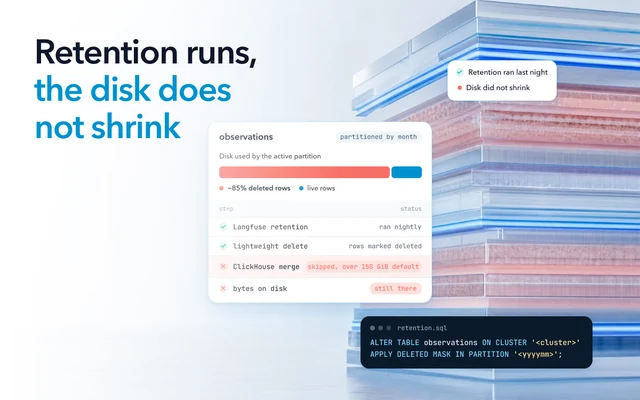
Deleting on a schedule is a separate feature. Langfuse's retention policies delete data nightly after a set number of days, with a minimum of 3. They come with Pro and Enterprise on Cloud, and with Enterprise when self-hosted. A self-hosted instance without a policy keeps everything.
For history older than 90 days, Langfuse Cloud needs Pro or above. For history older than 180 days, LangSmith's cloud has none.
What limits you hit first on a hosted plan
On LangSmith Plus, the hourly limits are 500,000 trace events and 5.0 GB of trace data, as of October 2026. Langfuse Cloud caps ingestion at 1,000 requests a minute on Hobby, 4,000 on Core and 20,000 on Pro.
On LangSmith, an event is the creation or the update of a run, and every step in a trace is a run. So although the bill counts traces, this limit counts steps. At 60 steps a trace, each created and then updated, one trace is 120 events, and the hourly limit is about 4,000 traces. The window resets at the top of each clock hour in UTC, and anything over it gets an HTTP 429 response.
Langfuse's SDKs send many events in one request, so the two limits cannot be compared directly. Test both against your busiest hour, not your monthly average.
Neither tool samples your traces unless you tell it to. LangSmith logs every trace by default, and LANGSMITH_TRACING_SAMPLING_RATE, from 0 to 1, keeps a share of them. Langfuse's default rate is 1, and LANGFUSE_SAMPLE_RATE samples in your code, per trace. On both, a dropped trace is never billed and can never be opened, which is why teams turn to sampling when the bill grows too fast.
What you run if you self-host each one
Self-hosting either tool means running ClickHouse, PostgreSQL, Redis and object storage. LangSmith allows it only with an Enterprise contract, and Langfuse allows it free under the MIT license.
Self-hosted LangSmith is an add-on to the Enterprise plan, and it runs in your own Kubernetes cluster. It keeps traces in ClickHouse, operational data in PostgreSQL, and queues and caches in Redis, with object storage alongside. LangChain also offers SmithDB, an optional datastore built for agent traces. For production, LangChain says to use external versions of each store. On top of those stores, self-hosted LangSmith runs six application services, against Langfuse's two.
Self-hosted Langfuse is free with unlimited usage under the MIT license. It is two application containers, a web server and a worker, plus PostgreSQL, ClickHouse, Redis or Valkey, and S3 or another object store. Langfuse's self-hosting docs describe Docker Compose as a single VM without high availability, scaling or backups, and point production at Kubernetes or a cloud deployment on AWS, Azure or GCP.
Some features of self-hosted Langfuse need its Enterprise edition: data retention policies, project-level access control and audit logs. That edition is sold bundled with a ClickHouse commercial plan.
If the cloud bill is what pushes you to self-host, Langfuse is the only one of the two you can run without an Enterprise contract. Budget for operating those four stores on Kubernetes, and for the people who keep them healthy.
Langfuse vs LangSmith: which team each one suits
Pick LangSmith when:
- your agents are built on LangChain or LangGraph, and you want tracing, evaluation, alerts and agent deployment from one vendor.
- your traces are deep, with dozens of steps each, so a per-trace price works in your favor.
- 14 days of history is enough for most traces, or you will pay to extend the ones that matter.
- the people who need access are few enough that seats stay a small part of the bill.
Pick Langfuse when:
- your stack mixes frameworks or custom code, and you want to instrument once with OpenTelemetry.
- you want to self-host on an open license, or keep months of viewable history on the cloud.
- many people need access, and you do not want a seat fee.
- your traces are shallow to moderate in depth.
If you are still unsure, run both on a week of real traffic. That gives you your own steps per trace, your own peak hour and your own bill.
Moving from one to the other
If you already run one of the two, moving new traces is a matter of where your spans go. Both tools accept OpenTelemetry. LangSmith's docs show an OpenTelemetry Collector sending one span stream to LangSmith and any other backend, so you can run both tools side by side while you compare. Datasets move separately: Langfuse imports them by CSV, SDK or API, and evaluators are set up again in the new tool.
Two details catch teams during a parallel run. LangSmith drops a span whose parent never reaches it, without returning an error, so send each tool whole traces. And the Langfuse SDK exports only LLM-relevant spans by default, so its unit count depends on that filter and on what else you choose to send.
Traces you already sent stay in the old tool. Keep it readable until its retention runs out, or until you no longer need that history.
How to check either side's claims
Check each claim against the owner's own documentation, then against your traffic. Both vendors publish a comparison of the two, each is written by one side, and the two pages disagree on facts. LangChain's page, dated April 2026, says "Langfuse has no alerting functionality." Langfuse's alerts docs list 2 alerts on Hobby, 20 on Core, 50 on Pro and 100 on Enterprise, with no limit on self-hosted version 4. LangSmith's own alerts cover problems such as latency increases and cost spikes, and route to Slack, PagerDuty or a webhook.
To check against your traffic:
- Export a week of traces and count the steps in each one, using the spans your exporter will send.
- Price both from the two pricing pages at that depth, with your real number of users.
- Open every LangSmith online evaluator and automation rule, and check whether it extends retention.
- Check your Langfuse plan's data access window against how far back you debug.
- For self-hosting, read each license and list every database you would operate.
- Load test your busiest hour against LangSmith's hourly event and data limits, or Langfuse's request limits.
When neither fits
At production volume, the bill often decides how much of each agent session a team keeps, and many teams sample to control it.
Traces go straight to object storage in Oodle's own columnar format, and queries run on serverless compute that spins up per query and shuts down after. So Oodle keeps every session in full for your retention period (30 days on Pro, longer for an added fee), and agent traces are kept with the logs, metrics and application traces of the same request.
Oodle bills by data ingested, with no seat fees and no query fees. Oodle has simple, ingest-based pricing, starting at $1 per GB, and is cost efficient.
Billing by the byte has its own weak spot. Every span is billed by its size, so data sent twice costs twice, and large traces with few steps can cost less on a per-unit or per-trace price.
Teams on the Langfuse SDK change only the endpoint. Teams on the native LangSmith SDK replace it with OpenTelemetry instrumentation and point the exporter at Oodle, and teams that already export OpenTelemetry to LangSmith point the same spans at Oodle. Pointed at Oodle, the Langfuse SDK still exports only LLM-relevant spans by default. So for one trace from the API request through the agent and its tools to the database, your services also send their own spans, through OpenTelemetry instrumentation or a permissive export filter, and pass trace context between them.
Oodle is not open source. Bring your own cloud (BYOC) and bring your own bucket (BYOB) are Enterprise options, for agent observability as well as logs, metrics and traces. With BYOB, a customer's data is kept in its own bucket under its own keys, and it stays readable with standard S3 tools if the customer leaves. A team that only needs LLM tracing, or runs at low volume where per-unit pricing costs little, may not need Oodle.